
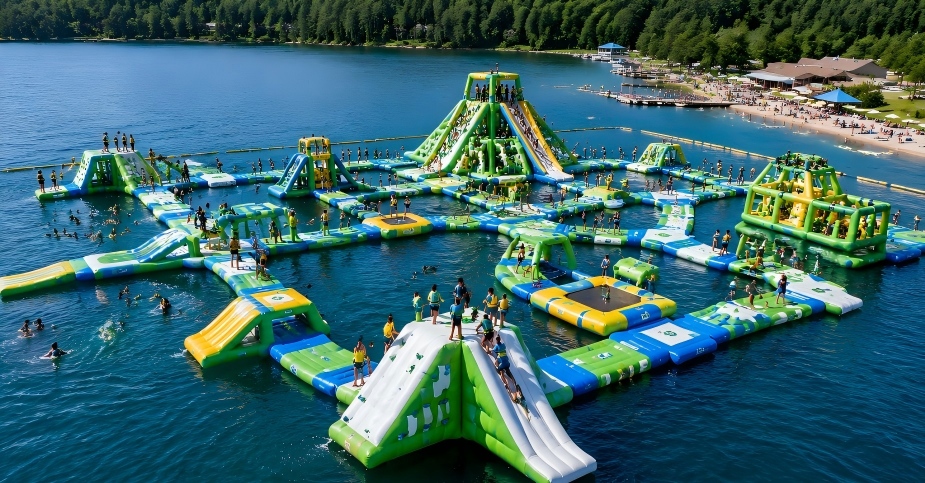
When planning a commercial inflatable water park project, one of the first questions operators need to answer is not only how large the attraction should be, but also how many visitors it can serve comfortably at one time.
A campground owner may need a smaller setup designed for weekend guests, while a resort or tourism destination may require a much larger attraction capable of handling hundreds of visitors during peak season.
Choosing the right capacity is important because an inflatable water park should balance three key factors:
- Visitor experience
- Operational efficiency
- Safety management
A park that is too small may limit revenue opportunities, while a park that is too large for the location may increase investment and operating costs without creating additional value.
Understanding how capacity is calculated helps operators choose a design that matches their location, customers, and business goals.
What Determines Inflatable Water Park Capacity?
The capacity of a commercial inflatable water park is influenced by more than the size of the equipment.
The main factors include:
- Park dimensions
- Layout design
- Available water area
- Types of attractions
- Visitor movement
- Safety requirements
- Operating procedures
A larger inflatable water park does not always mean better performance. A well-planned layout can provide a better visitor experience than a larger attraction with poor planning.
The goal is not simply to fit as many people as possible. The goal is to create a safe, enjoyable, and efficient attraction that matches the needs of the business.
Typical Capacity of Different Inflatable Water Parks
Different park sizes are suitable for different locations and business models.
| Park Size | Typical Capacity | Suitable For |
|---|---|---|
| Small Inflatable Water Park | Around 50–100 visitors at one time | Small lakes, campgrounds, private resorts |
| Medium Commercial Water Park | Around 100–250 visitors at one time | Resorts, tourism attractions, larger campgrounds |
| Large Inflatable Water Park | 250+ visitors at one time | Major tourism destinations and high-traffic locations |
Actual capacity depends on the specific layout, water area, attraction design, safety requirements, and operating conditions.
Small Inflatable Water Parks
Small commercial inflatable water parks are often suitable for:
- Small lakes
- Campgrounds
- Private resorts
- Community recreation areas
They are often easier to manage because they require:
- Lower initial investment
- Fewer staff members
- Less water area
- Simpler daily operation
For businesses entering the market, a smaller attraction can be a practical way to provide additional activities while controlling operating costs.
Medium Commercial Inflatable Water Parks
Medium-sized inflatable water parks are commonly used by:
- Resorts
- Popular campgrounds
- Tourist attractions
- Waterfront recreation businesses
They usually include a wider variety of activities, such as:
- Slides
- Climbing obstacles
- Floating walkways
- Balance challenges
- Interactive elements
This size often provides a good balance between investment, visitor experience, and operational efficiency.
Large Inflatable Water Parks
Large commercial inflatable water parks are designed for locations with strong visitor demand.
They are commonly used at:
- Major tourism destinations
- Large resorts
- Busy waterfront attractions
- Professional recreation facilities
Larger parks can provide more activities and longer visitor experiences, but they also require more attention to:
- Staff management
- Safety procedures
- Visitor flow
- Maintenance planning
A large attraction should always match the expected demand of the location.
How Design and Location Affect Capacity
Two inflatable water parks with similar dimensions may have different effective capacities depending on their design.
Layout Design
A well-designed layout helps distribute visitors across different areas.
For example:
- Slides
- Climbing zones
- Balance sections
- Obstacle areas
allow visitors to move between different activities instead of gathering in one location.
Good visitor flow depends on:
- Entry points
- Exit areas
- Popular attractions
- Waiting areas
- Connection routes
Poor layout planning can create congestion even when the total number of visitors is within the theoretical capacity.
Water Area Requirements
The available water area also plays an important role in capacity planning.
Before selecting equipment, operators should evaluate:
- Total water surface
- Water depth
- Safety zones
- Shore access
- Anchor placement
- Surrounding activities
A larger water area provides more flexibility for layout design and visitor movement.
Choosing the right equipment size should always begin with understanding the installation site rather than selecting a park first and trying to fit it afterward.
For more information about site selection, see:
Where to Build a Commercial Inflatable Water Park in Canada?
Capacity, Safety, and Visitor Experience
Capacity planning should always consider safety first.
More visitors require:
- Better supervision
- Clear operating procedures
- Effective visitor management
- Proper staff training
Operators should consider:
- Visitor age groups
- Experience levels
- Weather conditions
- Number of supervisors required
- Emergency procedures
A park may physically fit a certain number of visitors, but the recommended operating capacity may be lower depending on real-world conditions.
A successful inflatable water park is not the one with the highest number of visitors at one time. It is the one that provides a safe and enjoyable experience while operating efficiently.
For more information about safety planning, see:
Are Commercial Inflatable Water Parks Safe?
Planning Capacity for Different Businesses
The ideal capacity depends on the business model.
Campgrounds
Campground operators usually focus on improving guest experience.
A suitable water park can help:
- Increase guest satisfaction
- Encourage longer stays
- Add more family activities
Resorts
Resorts may require larger attractions because the water park becomes part of the overall guest experience.
Important considerations include:
- Number of guests
- Seasonal occupancy
- Available waterfront area
Tourism Attractions
Tourism operators may benefit from larger layouts designed for higher visitor volume.
However, the investment should always match realistic customer demand.
Choosing a suitable capacity helps avoid unnecessary costs while ensuring enough attraction value for visitors.
How Capacity Affects Business Performance
The right capacity can directly influence the success of an inflatable water park business.
A properly sized attraction can help improve:
- Visitor experience
- Staff efficiency
- Customer satisfaction
- Revenue opportunities
- Long-term business sustainability
A park that matches market demand is usually easier to operate than an oversized attraction with unnecessary investment and operating costs.
Capacity should be planned together with:
- Location
- Target customers
- Pricing strategy
- Operating season
- Future expansion plans
For more information about business planning, see:
How Profitable Is an Inflatable Water Park in Canada?
Common Capacity Planning Mistakes
Many operators focus only on maximizing visitor numbers.
However, bigger is not always better.
Common mistakes include:
- Choosing a park that is too large for local demand
- Ignoring staffing requirements
- Underestimating water area limitations
- Focusing only on ticket revenue
- Forgetting visitor experience
A successful inflatable water park should balance capacity, safety, and customer satisfaction.
Final Thoughts
So, how many people can a commercial inflatable water park accommodate?
The answer depends on:
- Park size
- Layout design
- Water area
- Visitor flow
- Safety management
- Operating strategy
Small parks may accommodate around 50–100 visitors at one time, while larger commercial attractions can handle 250 or more visitors depending on their design and operating conditions.
The best inflatable water park is not necessarily the largest one. It is the one that matches the location, customer demand, budget, and long-term business goals.
A carefully planned capacity allows operators to create a safer, more enjoyable attraction while maximizing the value of their investment.